Industrial Ice Machine Ice Types, Formation Mechanisms, and Application Scenarios
I. Different Ice Types Meet Different Industrial Requirements
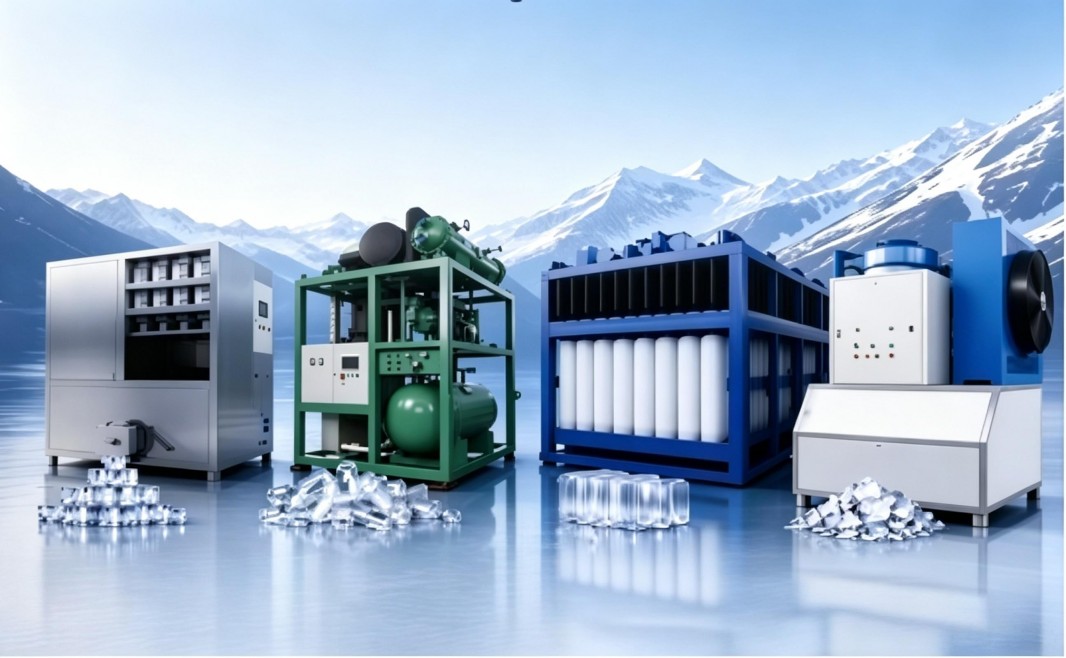
Industrial ice machines are designed to produce different types of ice for industrial and commercial processing applications. Depending on the ice-making technology, they can produce tube ice, flake ice, block ice, and nugget ice, each offering unique advantages in terms of cooling performance, storage, transportation, and process efficiency. Selecting the appropriate ice type according to the production process is essential for improving cooling performance, reducing operating costs, and ensuring product quality.
II. Differences in Ice Formation Mechanisms
Different ice types are produced using different evaporator designs and ice-making methods.
Tube ice is produced by freezing water inside vertical tube evaporators. Ice gradually forms on the inner wall of each tube until it reaches the required thickness, after which hot gas defrosting releases the ice. Tube ice is hard, transparent, and slow to melt, making it suitable for cooling, food processing, and beverage production.
Flake ice is produced by continuously freezing a thin layer of water on the inner surface of a vertical evaporator drum. A rotating ice blade continuously removes the ice, producing thin, dry flakes with a large contact area. Flake ice provides rapid heat transfer and is widely used wherever products require fast and uniform cooling.
Block ice is manufactured by freezing water inside large ice cans or molds over a relatively long freezing cycle. The resulting ice blocks are dense, durable, and highly resistant to melting, making them suitable for long-distance transportation and applications requiring extended cooling time.
Cube ice is produced by compressing fine ice particles into small, compact pellets. It offers excellent cooling efficiency and is suitable for certain food processing and cold-chain applications where uniform cooling is required.

III. Application Scenarios for Different Ice Types
Tube ice is widely used in food processing plants, beverage production, fisheries, and concrete cooling projects because of its hardness, cleanliness, and long melting time.
Flake ice is one of the most commonly used industrial ice types. Its large surface area enables rapid heat transfer without damaging products, making it ideal for seafood preservation, meat processing, poultry processing, vegetable cooling, and supermarket fresh food displays.
Block ice is commonly used in marine fishing, fish markets, long-distance cold-chain transportation, and construction projects where long-lasting cooling performance is required.
Nugget ice is suitable for selected industrial cooling processes, food manufacturing, and material temperature control applications that require fast and even heat removal.

IV. Selecting the Appropriate Industrial Ice Type
There is no single ice type that is suitable for every industrial application. The optimal choice depends on factors such as cooling efficiency, melting characteristics, transportation requirements, storage conditions, and production processes. By selecting the appropriate ice type and matching it with the correct industrial ice machine, users can improve production efficiency, reduce energy consumption, protect product quality, and achieve more reliable long-term operation.


