I. The Vapor-Compression Refrigeration Cycle
Industrial ice machines produce ice by using a vapor-compression refrigeration cycle to continuously remove heat from water. Unlike commercial ice machines that are mainly designed for restaurants, hotels, and beverage service, industrial ice machines are built for continuous, high-capacity operation in applications such as seafood processing, concrete cooling, mining, chemical processing, food manufacturing, and cold chain logistics. Although different machines produce different types of ice, the underlying refrigeration principle is the same: ice is formed by extracting heat from water rather than by generating cold.
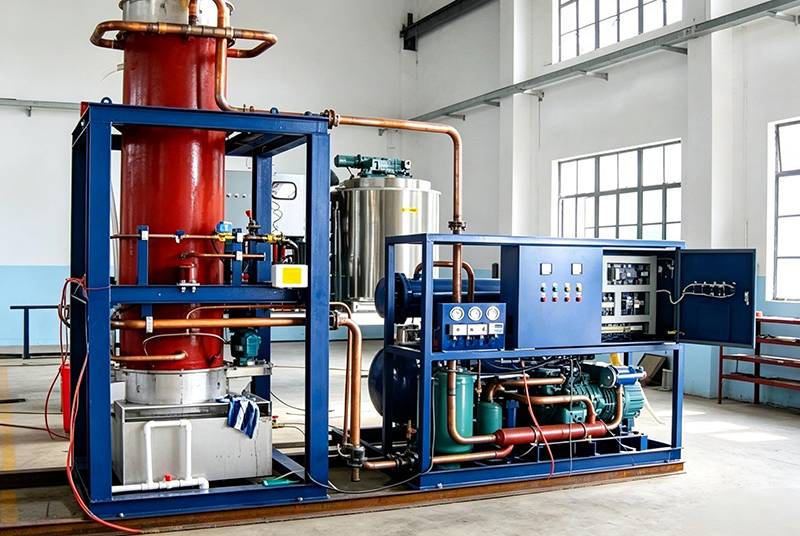
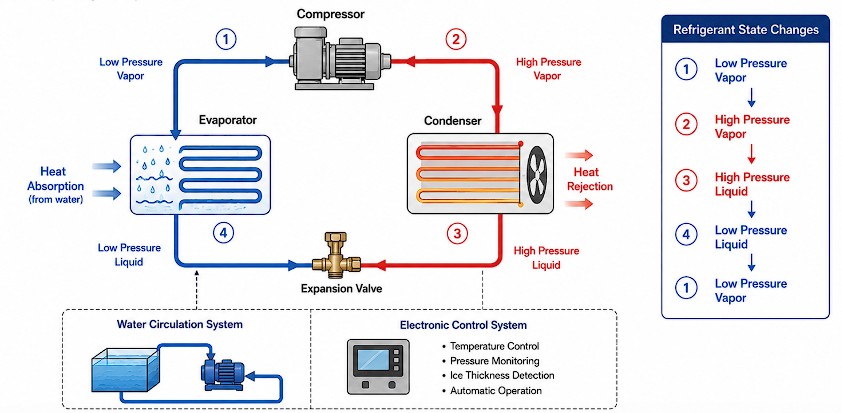
A typical industrial ice machine consists of a compressor, condenser, expansion device, evaporator, water circulation system, and electronic control system. These components operate together in a closed refrigeration circuit. Refrigerant continuously changes pressure, temperature, and physical state as it circulates through the system, allowing heat to be absorbed from the water and rejected to the surrounding environment. The efficiency of this heat transfer process directly determines ice production capacity, energy consumption, and operating stability.
II. The Refrigeration Cycle Transfers Heat
The refrigeration cycle begins at the compressor. Low-pressure, low-temperature refrigerant vapor leaving the evaporator enters the compressor, where it is compressed into high-pressure, high-temperature vapor. Compressing the refrigerant raises both its pressure and saturation temperature, enabling it to release heat effectively in the next stage of the cycle.
The high-pressure vapor then flows into the condenser. Depending on the machine design, the condenser may be air-cooled, water-cooled, or evaporatively cooled. As heat is transferred from the refrigerant to the cooling medium, the refrigerant condenses into a high-pressure liquid while remaining at nearly constant pressure. Efficient heat rejection is essential because poor condenser performance increases condensing pressure, reduces refrigeration efficiency, and increases compressor power consumption.
After condensation, the liquid refrigerant passes through an expansion valve or other metering device. During expansion, the refrigerant experiences a sharp pressure drop, causing its saturation temperature to decrease significantly. Part of the liquid flashes into vapor, producing a low-pressure, low-temperature liquid-vapor mixture before entering the evaporator.
Inside the evaporator, the refrigerant absorbs heat from the circulating water and gradually evaporates into low-pressure vapor. The absorbed heat includes the sensible heat required to cool the water to its freezing point and the latent heat required to convert water into ice. Once the refrigerant has completely evaporated, it returns to the compressor, completing the refrigeration cycle and allowing continuous ice production.
III. The Evaporator Determines Ice Formation
The evaporator is the component where ice is actually formed, and its structural design determines both the ice-making method and the final ice shape. Although industrial ice machines produce different products, every design relies on efficient heat transfer between the refrigerant and water.
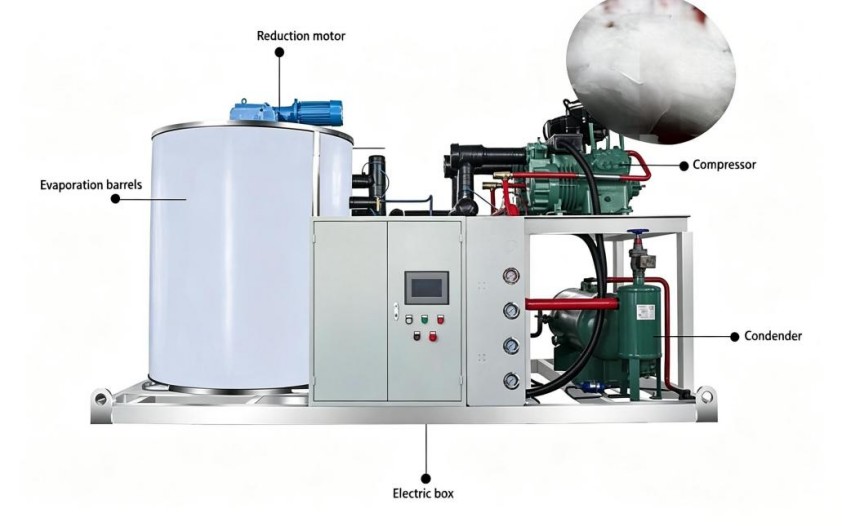
In flake ice machines, water forms a thin ice layer on the inner or outer surface of a refrigerated drum, and a rotating blade continuously removes the ice as thin flakes. Tube ice machines freeze water inside vertical evaporator tubes until a hollow cylindrical ice structure is formed before harvesting. Block ice machines freeze large volumes of water in containers or molds over a longer freezing period, producing solid blocks with high thermal storage capacity. Plate ice machines freeze water on flat evaporator plates to produce large sheets of ice that are later broken into smaller pieces if required.
Because each ice type has different thickness, surface area, and melting characteristics, the evaporator design is optimized according to the intended industrial application.
IV. Automatic Harvesting Ensures Continuous Operation
When the ice reaches the required thickness or size, the control system initiates the harvesting process. Different industrial ice machines use different harvesting methods depending on their evaporator design. Many tube ice and plate ice machines use hot gas defrost, in which high-temperature refrigerant is temporarily directed through the evaporator to slightly warm its surface. This creates a thin water film between the ice and the evaporator, allowing the ice to separate without damaging the heat transfer surface. Flake ice machines generally do not require a separate harvest cycle because rotating blades continuously remove newly formed ice during operation.
Automatic sensors monitor operating conditions such as ice thickness, water level, pressure, and temperature. Once harvesting is completed, the machine immediately resumes refrigeration, allowing continuous and reliable operation with minimal manual intervention.


